
1. Comic Opening
Comic text version (scenes and dialogue)
| Panel | Scene | Dialogue |
|---|---|---|
| 1 | Pip, the pocket-watch time machine and Professor Arpa. | Pip: "Professor, was the Internet suddenly invented one day?" Professor Arpa: "Of course not! Climb into the time machine and take a look!" |
| 2 | 1844: a telegraph machine, a wooden pole, and dot-and-dash signals floating along the wire. | Caption: "1844: The Telegraph uses wires to send 'beep, beep-beep' signals far away." Pip: "Dot-dash-dot... words have turned into electrical signals!" Professor Arpa: "But a wire only joins two places, you know." |
| 3 | 1969: two wardrobe-sized computers, UCLA and SRI, joined by a wire. The screen shows "LO" with "Crash!" beside it. | Caption: "1969: ARPANET sends its first message (it was meant to be LOGIN)." Pip: "Only the L and the O got through before the computer crashed!" Mac: "Computers back then were bigger than wardrobes!" |
| 4 | A winding road with signposts reading 1983 TCP/IP, 1991 World Wide Web, and Today: phones and the cloud. | Caption: "Networks grew up step by step, and became today's Internet." Professor Arpa: "Take your time, but never stop. Networks are just like me!" |
2. Key Idea
The Internet is like a city. It wasn't built in a day. It grew from a little village, one bridge and one road at a time.
In 1969, ARPANET used Packet Switching to connect 4 computers. In 1983 it switched to TCP/IP, a shared set of rules that lets all kinds of devices talk to one another. From then on, different networks could join up and become the Internet. In 1991 the World Wide Web opened to the public, and ordinary people could get online easily.
3. A Closer Look
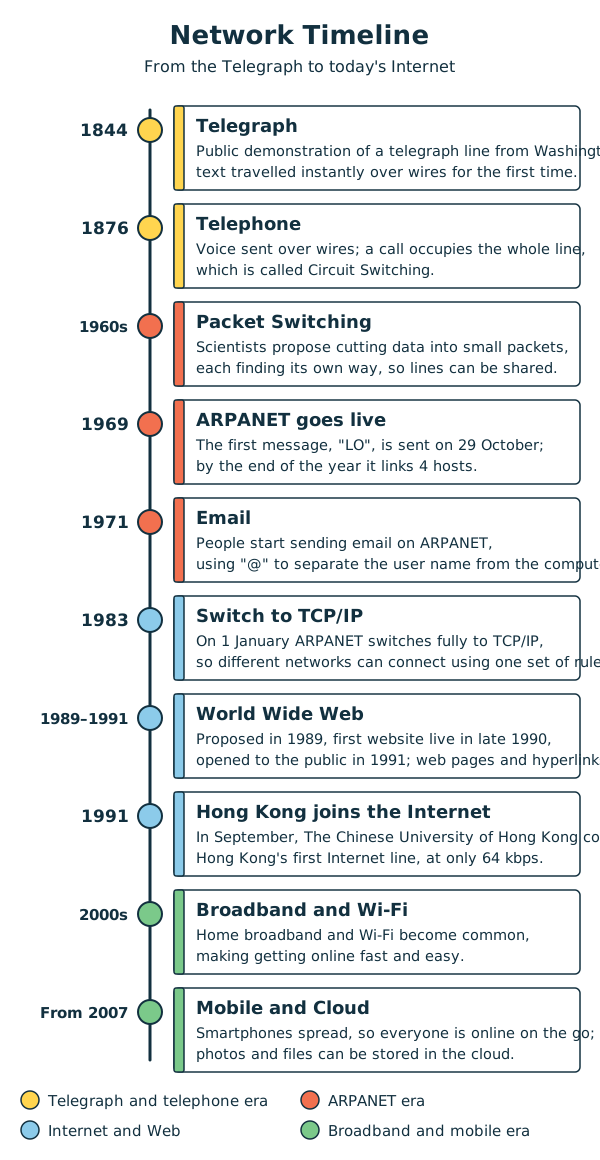
Diagram: a timeline of network history.
Before networks: the Telegraph and the Telephone
In 1844, a telegraph line between Washington and Baltimore in the United States was shown to the public. The Telegraph is a way of communicating by sending long and short electrical signals along a wire to stand for words. The operator pressed the telegraph key and turned words into dots and dashes called Morse Code, and for the first time words could reach far-away places instantly.
In 1876 the Telephone appeared, and wires began to carry voices. When you made a call, the phone company connected a line from your home to the other person's home, and that line was reserved for the two of you for the whole call. This method is called Circuit Switching.
A new idea: Packet Switching
In the 1960s, some scientists came up with a new method: cut data into many small pieces called Packets, let each Packet find its own way, and put them back together when they arrive. This is Packet Switching.
It has two big advantages:
- Everyone shares the lines. Packets take turns using the line one after another, so a single conversation doesn't hog the whole line.
- If one road is cut, there are others. When part of a line has a problem, Packets can take a different route.
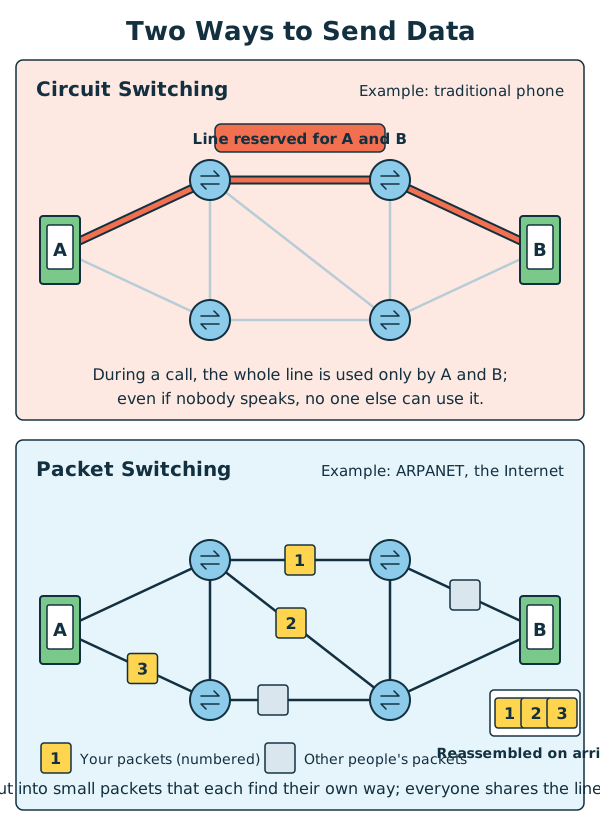
Diagram: the top half shows Circuit Switching, as used by the telephone, where A and B take up one whole dedicated line. The bottom half shows Packet Switching, where data is cut into numbered Packets that each find their own way, and the lines are shared by everyone.
1969: ARPANET is born
ARPANET was funded by ARPA, a research agency of the United States Department of Defense. Its main aim was to let scientists at universities and research institutes share the very expensive computers of the time. It was one of the first networks in the world to use Packet Switching.
- 29 October 1969: a computer at UCLA (University of California, Los Angeles) tried to log in to a computer at SRI (Stanford Research Institute). After the letters L and O were typed, the system crashed, so the first message was "LO".
- End of 1969: ARPANET connected 4 host computers, at UCLA, SRI, UCSB (University of California, Santa Barbara) and the University of Utah.
- 1971: Email appeared on ARPANET and began using "@" to separate the user name from the computer name. Email addresses still use this symbol today.
1983: everyone speaks the same language
By the 1970s, besides ARPANET there were other networks too, such as satellite networks and radio networks. The problem was that each had its own rules, so they couldn't talk to one another.
In 1974, Vint Cerf and Bob Kahn published a design that let different networks connect to each other. It later grew into TCP/IP.
On 1 January 1983, ARPANET switched over completely to TCP/IP. From then on, any network that followed TCP/IP could plug in. This is the "network of networks" from Lesson 1, so many people regard this day as the Internet's "birthday". The details of TCP/IP come later, in Lessons 5 and 9.
1989 to 1991: the World Wide Web
The early Internet was used mainly by researchers, who had to type commands to operate it, so it was hard for ordinary people to get started.
In 1989, Tim Berners-Lee, who worked at CERN (the European Organization for Nuclear Research), proposed the idea of the World Wide Web:
- Information is placed on Web Pages, one page at a time.
- Pages are joined by Hyperlinks, so one click takes you to another page.
- A Browser is all you need to read the pages.
The first website went live at CERN in December 1990. The World Wide Web opened to the public in August 1991. On 30 April 1993, CERN announced that Web technology was free for everyone to use, and the number of websites shot up from then on.
The Internet and the Web are not the same thing! The Internet is like the world's road system. The World Wide Web is one of the services that run on those roads, like a courier company. Email, video calls and online games also use the Internet, but none of them is the Web.
Hong Kong gets online!
In September 1991, The Chinese University of Hong Kong connected the first Internet line in Hong Kong, at a speed of only 64 kbps, and later opened it up to other tertiary institutions in Hong Kong. Many home broadband plans today reach 1 Gbps, about fifteen thousand times faster than that line.
Today: the Mobile and Cloud era
- The 2000s: home broadband and Wi-Fi became common.
- From 2007: smartphones became popular, and going online changed from "sitting at a computer" to "anytime, anywhere". This is the Mobile era.
- Today: photos, documents and videos can all be stored in the Cloud, which means using services provided by remote servers over the Internet.
From 4 host computers in 1969 to more than half the world's population online today, networks really did grow "step by step" into what they are now.
4. Try It Yourself
Task 1: Visit the world's first website
- Open your browser and type
info.cern.ch. - Click "Browse the first website". This is the first website, put back online by CERN.
- See what it has: only text and blue Hyperlinks, with no pictures and no videos.
- Think about it: compared with the websites you use today, what is the biggest difference?
This is CERN's real website, not one of the example addresses used in this lesson.
Task 2: A family "oral history of going online"
Interview a family member or an older relative and ask:
- In which year did you first go online? What device did you use?
- How long did you have to wait to get online? Did you hear the "beep-beep-beep" of a dial-up modem?
- What was your first email address, or the first website you used?
Write the answers on a timeline of your own family.
Mini game
Put the timeline in order
Put these six cards in order of time.
- The World Wide Web opens to the public
- The Telegraph is shown to the public
- ARPANET switches completely to TCP/IP
- The Telephone appears
- Smartphones become popular
- ARPANET sends its first message, "LO"
5. Where the Analogy Breaks
- The time machine is just a storytelling tool. The comic squeezes more than a hundred years of history into four panels, and many important inventions and people in between aren't drawn. The Internet wasn't invented by one person. It is the work of countless people.
- The Internet has no real "birthday". 1 January 1983 is often called the Internet's birthday, but networks developed step by step, and there was no single day when it suddenly "switched on".
- Networks aren't slow. Professor Arpa says "take your time", but networks have in fact been growing faster and faster: from 4 host computers in 1969 to billions of devices today.
- A common misunderstanding: was ARPANET built to survive a nuclear war? Not exactly. ARPANET was mainly built so that researchers could share computers. The Packet Switching feature of "if one road is cut, there are others" did come from early research on how communication networks could survive damage, but that was not ARPANET's own main purpose.
- The first message wasn't sent in one go. In the comic, Pip carries the L and the O together. In reality, each letter was sent as it was typed, and the system at SRI crashed when the third letter, G, was typed.
- Signposts on the same road don't mean they are the same kind of thing. The three things on the signposts appeared one after another in time, but one is a set of rules, one is a service and one is a device, and each plays a different role.
6. Quiz
7. Key Notes
- The Internet wasn't invented in a day: it grew step by step from the Telegraph and the Telephone to what we have today.
- Packet Switching cuts data into Packets that each find their own way, so lines can be shared by everyone.
- In 1969 ARPANET sent its first message, "LO". In 1983 it switched completely to TCP/IP, and from then on different networks could connect to one another.
- The World Wide Web opened to the public in 1991. The Web is a service that runs on the Internet, and the two are not the same thing.
- Hong Kong joined the Internet in September 1991, and today we are in the Mobile and Cloud era.
Next Stop
There are billions of devices on the network. How do you tell who is who? Mac will show you the name tag on his chest.